Key Findings
- 49 days — median active search time (first tour to signed lease) for NYC private offices in H1 2026, nearly twice SF’s 27 days.
- $64/SF/yr — median asking rate for offices in Manhattan, ranging from $35/SF in the Garment District to $93/SF in Tribeca. The spread reflects a substantial variance in building class and quality.
- Chelsea closes; Flatiron browses. Flatiron is the most-searched neighborhood in H1 2026 — but Chelsea is where the market actually clears, driven by its $28/SF price advantage over Flatiron on comparable space.
- 37% of NYC startup founders complete their entire office search in a single tour day, touring a median of 4 spaces. The 63% who take multiple days are typically revisiting finalists with a second decision-maker.
- Move-in readiness and growth room dominate every discovery call. Executives arrive with a hard deadline and a specific headcount target. Lease flexibility (under 3 years) and 1–2 conference rooms are the most common space-specific asks.
How Long Does It Take to Lease Office Space in New York City?
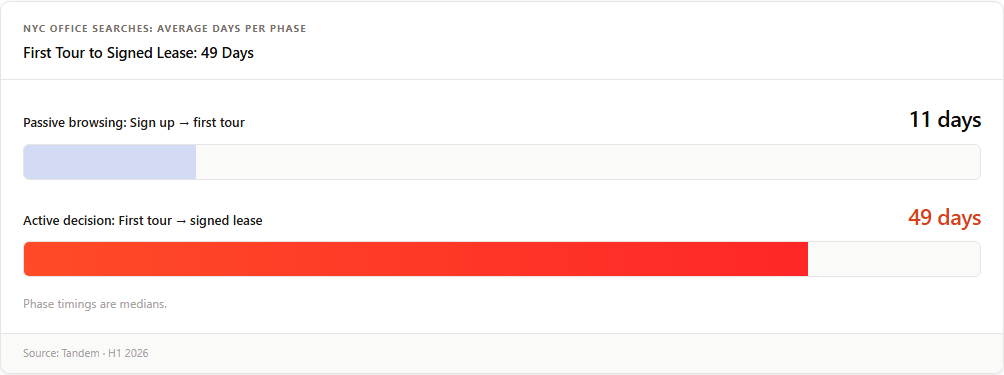
New York City office searches reach the first tour quickly — just 11 days of passive browsing before touring — but then spend 49 days in active negotiation before signing. This is nearly twice the 27-day active phase in San Francisco. Typically, leases in New York City have more complex legal reviews than in markets like San Francisco, partially attributable to elements like the Good Guy Guarantee.
Build 8–10 weeks from first tour to move-in into any NYC office search timeline: about 7 weeks to a signed lease, plus 1–3 weeks to move into a ready suite. A landlord who won’t accommodate that process is not being difficult — attorney review and guarantee structuring can take time even when both parties want to close. The fastest closings happen when founders arrive at the first tour knowing what they want and can put in an offer quickly.
New York City Office Space Pricing by Neighborhood (H1 2026)
NYC office market reports typically cite Midtown Class A asking rates — figures that reflect trophy towers leased by financial services and law firms, and bear little resemblance to what a 12-person team pays for a suite in Chelsea. For smaller offices, sub 5,000 square feet, asking rates in H1 2026 ranged from $35/SF/yr in the Garment District to $93/SF/yr in Tribeca. The median asking rate across startup-scale Manhattan neighborhoods was $64/SF — a figure that does not appear in any CBRE or JLL quarterly report because those reports do not track suites at this scale.
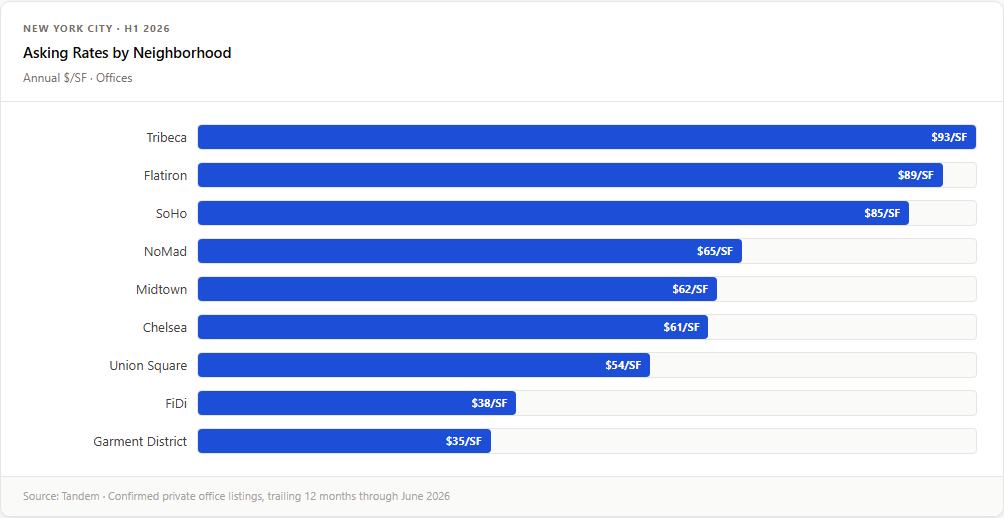
The highest-priced neighborhoods — Tribeca, SoHo, Flatiron — offer converted loft buildings with the exposed brick, high ceilings, and character that executives often mention in early conversations. The lowest-priced neighborhoods — Garment District, FiDi— offer commodity space in mid-century buildings at a significant discount. Chelsea, the most active closing neighborhood in H1 2026, sits at $61/SF — below SoHo and Flatiron but with comparable building quality — which likely explains why it converts more searches to leases than either of its neighbors.
The $58/SF spread between Tribeca and the Garment District is one of the widest pricing ranges in any city Tandem operates in. It reflects a NYC-specific dynamic: proximity to residential desirability commands a premium disconnected from pure office quality. A team that wants exposed brick and a neighborhood where founders actually live will pay 2.5× what a team in the Garment District pays for a comparable private desk count. Both are valid choices; what matters is knowing the premium is real before setting a budget.
What Does NYC Office Space Cost Per Person?
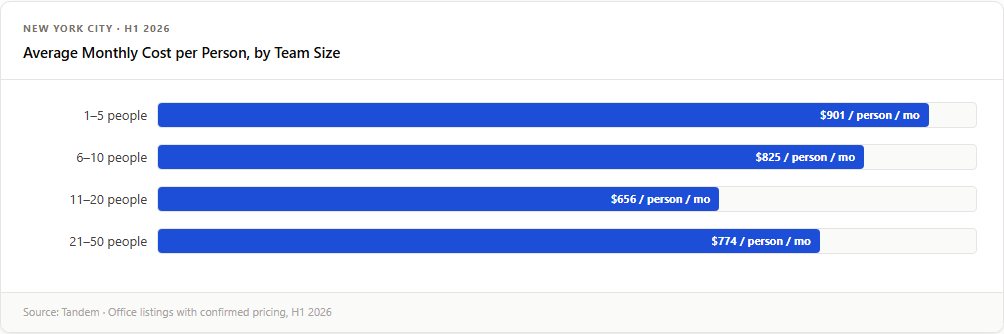
All-in monthly cost per person follows a U-shaped curve by team size — not the simple scale discount you might expect. Small teams (1–5 people) average $901/person/month, partly because Manhattan’s minimum viable private suite rarely rents for under $3,500/month regardless of headcount. Teams of 6–10 average $825/person/month. Mid-size teams (11–20 people) get the best value at $656/person/month, well below the per-desk price of a private office at a major coworking provider. The 21–50-person range climbs back to $774/person/month, reflecting the scarcity of larger startup-accessible suites in Manhattan’s most desirable neighborhoods.
These figures use a market-standard 150 square feet per person as the allocation baseline. Teams in the 11–20-person range negotiating a private lease have the most leverage they will have at any point in their growth: enough demand to give landlords a real tenant, but not so large that they need full-floor inventory where competition is different.
Which NYC Neighborhoods Are Most In-Demand For Office Space?
Manhattan’s startup office activity is concentrated in a handful of neighborhoods — but search activity and deal closings do not always align. The neighborhoods clients search most often are not always the ones where they end up signing. Understanding the gap between browsing and transacting tells you more about where the market clears than any ranking of “top startup neighborhoods.”
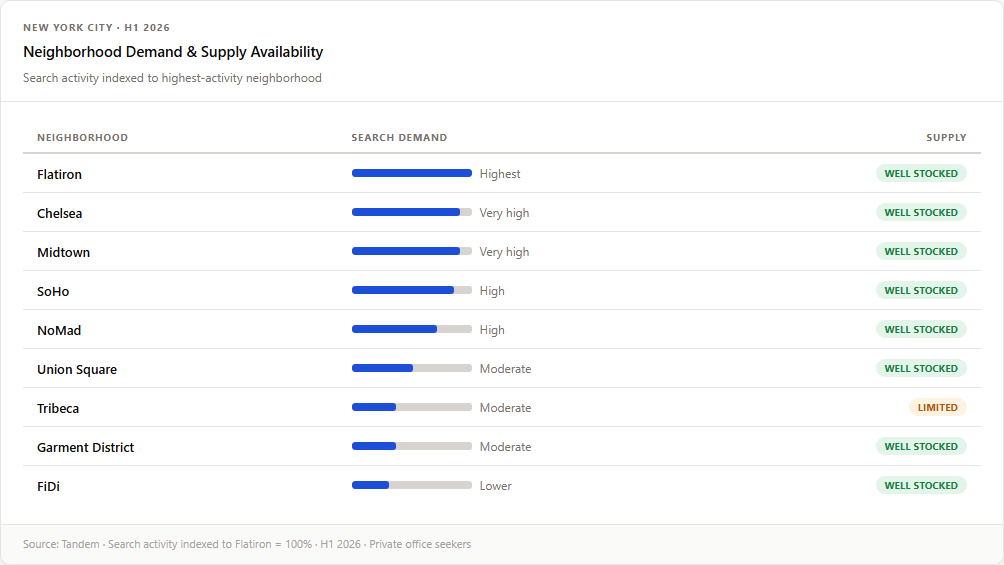
Flatiron generates the most search activity among startup teams on Tandem and has the inventory to support it. But Chelsea closes more office leases — a direct reflection of its $28/SF price advantage over Flatiron on comparable space. For a 2,000 SF suite, that spread is $56,000 per year. Once a search is live and budgets are concrete, that number becomes decisive for most teams.
SoHo draws high search interest for the same reasons Tribeca does — character, building quality, founder-friendly blocks — but its $85/SF asking rate pushes many searches toward adjacent neighborhoods as the search progresses. FiDi and the Garment District offer the lowest rents in Manhattan but remain underrepresented in search activity relative to their inventory, which can make them genuinely undervalued options for teams willing to trade the loft aesthetic for a lower monthly number.
How Do Startups Search for Office Space in New York City?
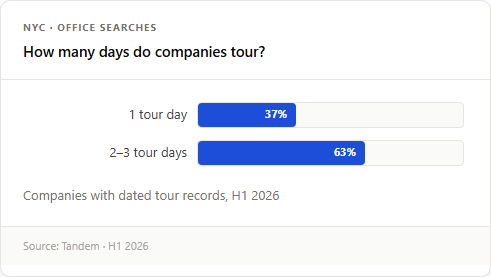
37% of NYC clients on Tandem complete their entire search in a single tour day, touring a median of 4 spaces in one session. The 63% who schedule a second round are typically returning with a co-founder or key hire who was not on the first tour, or revisiting a finalist to confirm details before making an offer.
What Do NYC Founders Actually Need in an Office?
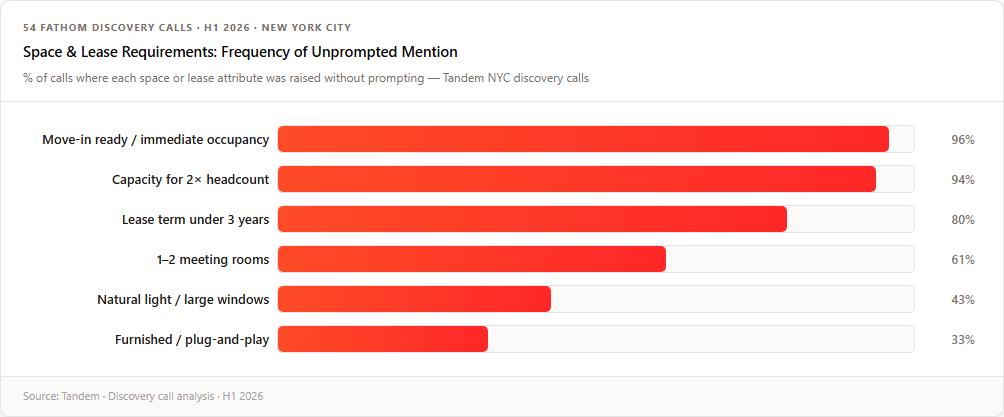
Based on dozens of discovery calls with NYC-based companies conducted January through June 2026, the most common unprompted requirements were:
- Move-in ready / immediate occupancy — mentioned by 96% of teams. Teams almost always have a hard deadline — lease expiring, team growing out of a coworking space, or a funding close that accelerates the timeline. Spaces that need buildout or have long lead times get cut early.
- Capacity for 2× headcount — 94%. The universal ask across every market Tandem operates in. NYC founders want a suite that works for the team they have and the team they plan to have in 18 months.
- Lease term under 3 years — 80%. Unlike coworking where month-to-month is standard, NYC office landlords typically want 2–5-year commitments. The Good Guy Guarantee has made shorter terms more accessible, but founders still have to negotiate around them.
- 1–2 meeting rooms — 61%. Not a nice-to-have for teams that run investor meetings, client calls, or all-hands from their office. The ask is usually specific: one or two rooms that seat 6–8 people.
- Natural light / windows — 43%. Interior suites in Manhattan midrise buildings are common and often priced at a discount. Teams spending significant time in an office treat natural light as a filter, not a preference.
- Furnished / plug-and-play — 33%. Particularly common among teams relocating or moving fast. A furnished suite with working Wi-Fi and existing conference room furniture eliminates a $15,000–$50,000 buildout conversation.
The dominance of move-in readiness and growth room at the top reflects where most NYC startups are in their planning horizon when they start an office search. A team that has raised a seed or Series A wants space that works for the next 12–18 months — not a 5-year commitment they may not grow into, and not a space that requires 8 weeks of buildout before they can move in.
How We Collected This Data
This report is based on first-party data from Tandem’s office leasing platform. Deal timeline data reflects the time between a user’s account creation and first scheduled tour (passive browsing phase) and the time between first tour and a signed lease (active decision phase), drawn from completed office transactions in New York City through H1 2026.
Pricing data reflects confirmed asking rates from active private office listings on the Tandem platform, using a trailing 12-month window through June 2026. Per-person cost figures use a 150 square foot per person allocation. Neighborhood search activity is indexed to the highest-activity neighborhood.
Discovery call data is drawn from dozens of calls with NYC-based teams conducted January through June 2026. Requirements were coded from call summaries and transcripts; percentages reflect the share of calls in which each criterion was mentioned unprompted.
All data reflects the New York City market only unless otherwise noted.
Last updated: October 2026
This post was created with the assistance of AI tools. All content was reviewed by the author.