Recognition, purpose, and diversity describe three different relationships between a company and its people. Recognition is whether someone's work gets noticed day to day. Purpose is whether that work adds up to something worth caring about. Diversity is who gets a seat at the table, and whose ideas get heard once they are there. A workplace can fake any one of the three for a while, but together they set how it actually feels to work somewhere, and that feeling drives the outcomes leaders track: retention, innovation, growth. The numbers below come from the landmark studies on all three topics, kept in their original wording (the source pages have since vanished from the web) and updated with the newest research.
The headline numbers at a glance
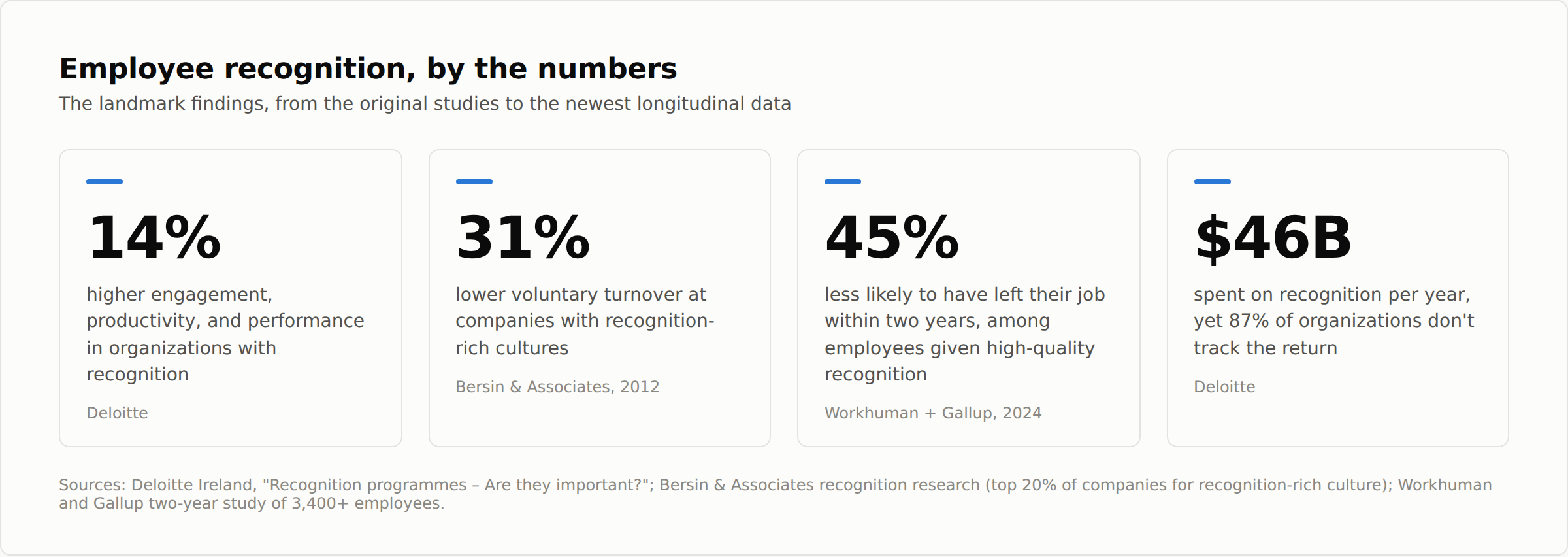
- Employee engagement, productivity, and performance are 14% higher in organizations with recognition programs than in those without (Deloitte)
- A 15% improvement in engagement can result in a 2% increase in margins (Deloitte)
- Companies spend roughly $46 billion per year on recognition, yet 87% don't track the return (Deloitte)
- Companies with recognition-rich cultures have 31% lower voluntary turnover (Bersin & Associates)
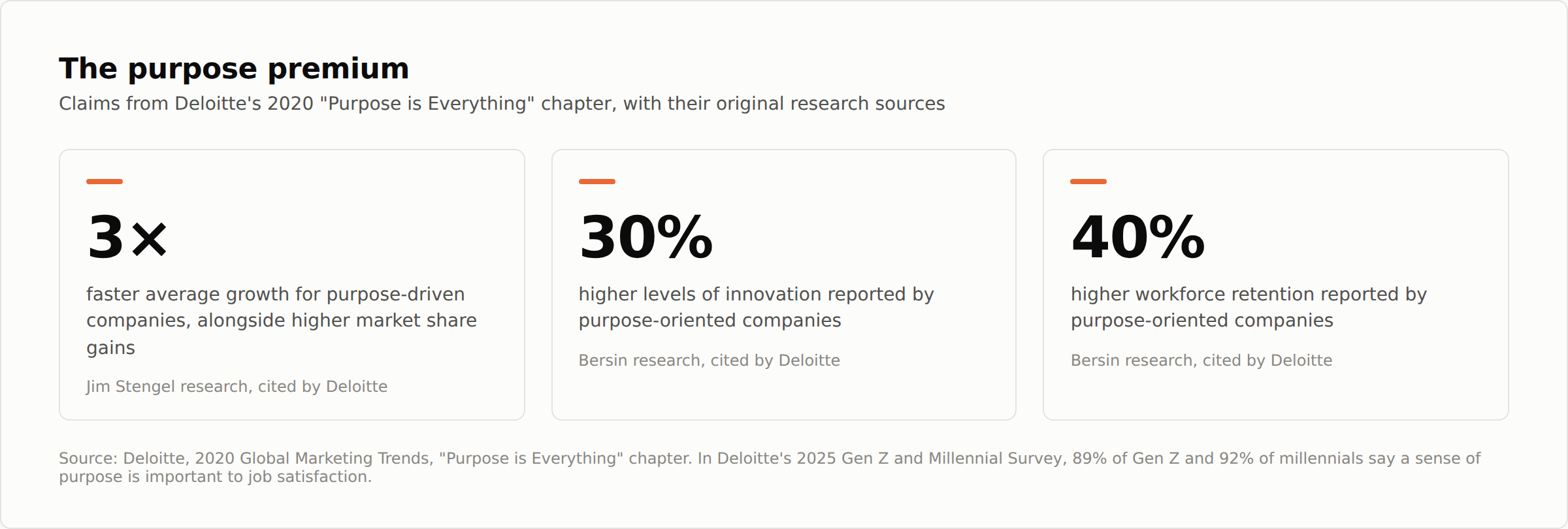
- Purpose-driven companies see higher market share gains and grow on average three times faster than competitors (Deloitte, 2020 Global Marketing Trends)
- Purpose-oriented companies report 30% higher innovation and 40% higher workforce retention than competitors (Deloitte, citing Bersin research)
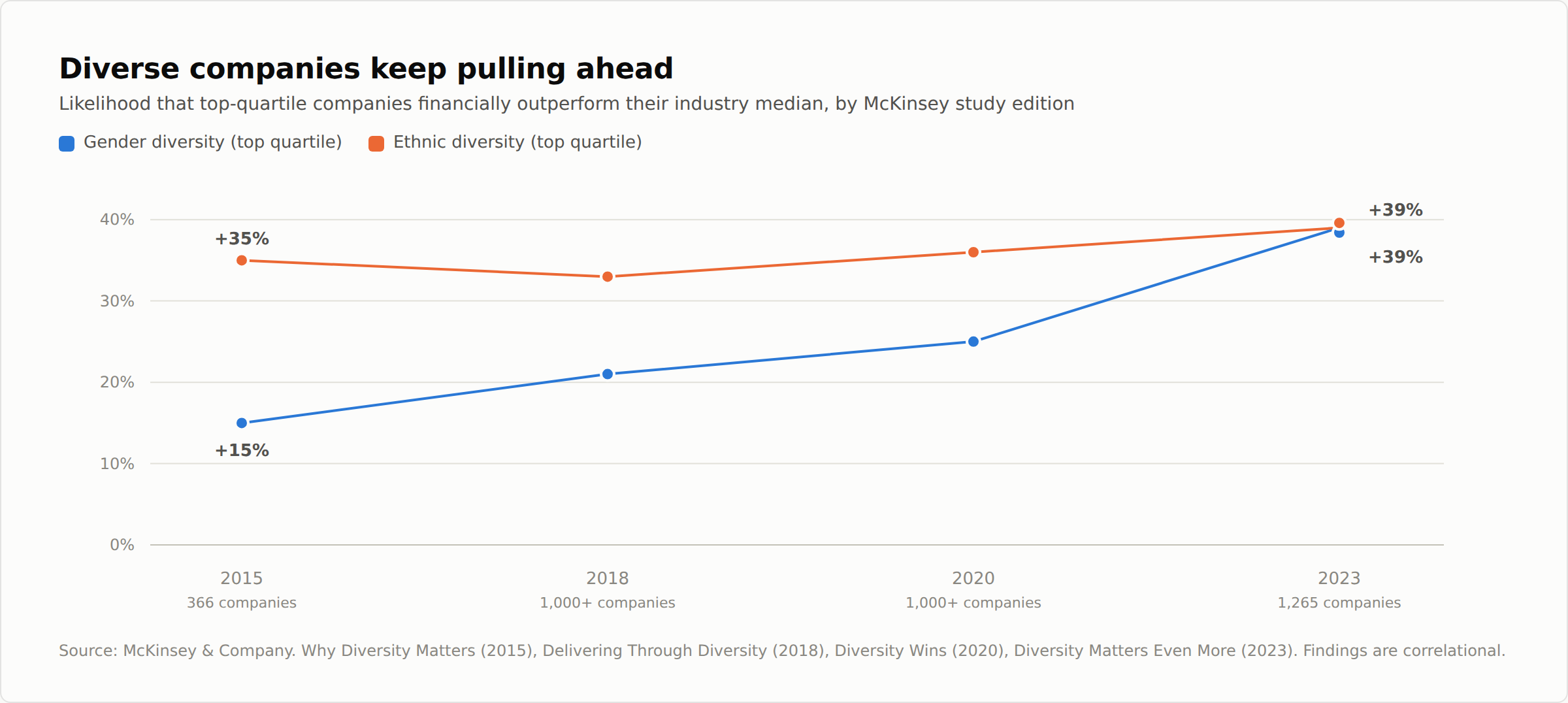
- Companies in the top quartile for gender diversity were 15% more likely to outperform financially in 2015; by 2023 that figure had risen to 39% (McKinsey)
- Companies in the top quartile for ethnic diversity were 35% more likely to outperform in 2015, and 39% more likely in 2023 (McKinsey)
Employee recognition statistics
What the original study found
The source is a Deloitte article titled "Recognition programmes – Are they important?", published under the firm's Deloitte Private practice and built largely on research by Bersin & Associates (later Bersin by Deloitte).
The main findings:
- Employee engagement, productivity, and performance are 14% higher than in organizations without recognition.
- A 15% improvement in engagement can result in 2% increase in margins.
- Despite spending $46 billion per year, it is surprising that most don't track the return (87%).
- Only 60% of organizations tie recognition to business goals.
- Over 80% of organizations have some form of recognition program in place.
A closer look at two of the numbers
Two of these numbers have drifted from their original wording over the years, so here is the precise version.
The 87% is about ROI tracking, not tenure awards. On the Deloitte page, 87% refers to organizations that spend on recognition without tracking the return. Separately, Bersin's underlying research found that 87% of recognition programs are tenure-based, built around years-of-service awards. Both numbers are real; they measure different things.
The turnover stat has a qualifier. Bersin's 2012 research found that companies scoring in the top 20% for building a "recognition-rich culture" had 31% lower voluntary turnover rates. The 31% belongs to that top tier of companies, not to anyone who launches a program. Bersin also found that only 17% of companies actually fit the recognition-rich profile, and that only 58% of employees even knew their company had a service-award program.
A related figure worth keeping in circulation: 82% of employees consider recognition an important part of their happiness at work, according to a 2019 SurveyMonkey study run with Bonusly across 1,511 employed US adults. The same survey found that 63% of people who are regularly recognized say they are very unlikely to job hunt in the next six months, against 11% of those who are rarely or never recognized.
What newer research shows
The original findings have aged well. If anything, the newest longitudinal data makes a stronger case:
- Employees who received high-quality recognition in 2022 were 45% less likely to have left their jobs by 2024, based on Workhuman and Gallup research tracking more than 3,400 employees over two years.
- 55% of US employees receive either no recognition at all or recognition that fails every quality marker Gallup measures.
- Employees who receive valuable feedback are 5 times as likely to be engaged.
- Employees whose recognition meets four or more of Gallup's five quality pillars are 4.4 times more likely to strongly agree that their job gives them a sense of purpose.
The through-line from 2012 to today: recognition keeps showing up as one of the cheapest retention levers a company has, and most companies still run it as a legacy service-awards program with no strategy attached.
Purpose-driven company statistics
Where the numbers come from
"Purpose is Everything" was the lead chapter of Deloitte's 2020 Global Marketing Trends report, published in late 2019.
Here's what it found:
- Purpose-driven companies witness higher market share gains and grow on average three times faster than their competitors, all while achieving higher workforce and customer satisfaction. The growth figure traces to brand-growth research by Jim Stengel, cited in the chapter's endnotes.
- Purpose-oriented companies report 30% higher levels of innovation and 40% higher levels of workforce retention than their competitors. Deloitte's endnote credits this to research by Josh Bersin, the same analyst behind the recognition findings above.
- In Deloitte's 2019 consumer pulsing survey of 4,000 people across the US, UK, China, and Brazil, the top factors people weigh when judging a brand were how it treats the environment (28%), how it treats its employees (20%), and how it supports its community (19%).
- More than 80% of consumers said they would be willing to pay more if a brand raised prices to be more environmentally or socially responsible, or to pay higher wages.
- Unilever's sustainable-living brands delivered 75% of the company's growth and grew 69% faster than the rest of its portfolio in 2018.
What newer research shows
Deloitte's follow-up work has shifted the purpose conversation from marketing claims toward talent outcomes, and the newest workforce data explains why:
- 89% of Gen Z and 92% of millennials say a sense of purpose is important to their job satisfaction and well-being, according to Deloitte's 2025 Gen Z and Millennial Survey of 23,482 respondents across 44 countries.
- Among workers reporting positive mental well-being, 67% of Gen Z and 72% of millennials feel their job lets them contribute meaningfully to society; among those with poor well-being, those figures drop to 44% and 46%.
- Deloitte's Monitor Institute now frames purpose as a driver of six kinds of business value: brand and reputation, sales and innovation, capital access, operational efficiency, talent, and risk mitigation.
Workplace diversity statistics
The research behind the stat
McKinsey's "Why Diversity Matters" was published in January 2015 by Vivian Hunt, Dennis Layton, and Sara Prince. Its findings ran in Time, Fortune, WIRED, Forbes, and the World Economic Forum's blog, and they still anchor hundreds of corporate diversity pages. The study analyzed proprietary data from 366 public companies across Canada, Latin America, the United Kingdom, and the United States.
Its findings:
- Companies in the top quartile for gender diversity on executive teams were 15% more likely to have financial returns above their national industry median.
- Companies in the top quartile for racial and ethnic diversity were 35% more likely to outperform their national industry median.
- In the UK, every 10% increase in senior-team gender diversity correlated with a 3.5% rise in EBIT.
- In the US, the relationship between ethnic diversity and performance was linear: every 10% increase in senior-team ethnic diversity correlated with a 0.8% rise in EBIT.
- The gap was large: at the time, women held just 16% of executive-team seats in the US and 12% in the UK.
How the numbers have moved across four editions
McKinsey has rerun the analysis three times, each with a larger dataset. The likelihood of outperformance linked to gender diversity has more than doubled since the original study.
|
Edition |
Year |
Dataset |
Gender top quartile |
Ethnic top quartile |
|---|---|---|---|---|
|
Why Diversity Matters |
2015 |
366 companies, 4 countries |
+15% |
+35% |
|
Delivering Through Diversity |
2018 |
1,000+ companies, 12 countries |
+21% |
+33% |
|
Diversity Wins |
2020 |
1,000+ companies, 15 countries |
+25% |
+36% |
|
Diversity Matters Even More |
2023 |
1,265 companies, 23 countries |
+39% |
+39% |
The 2023 edition added a finding about the other end of the distribution: companies in the bottom quartile for both gender and ethnic diversity are 66% less likely to outperform financially on average, up from 27% in 2020. In McKinsey's framing, the penalty for lagging is growing faster than the premium for leading.
Context worth knowing
McKinsey's diversity series measures correlation, not causation, and the firm says so in its methodology. The studies have also drawn academic scrutiny: a 2024 analysis by Jeremiah Green and John Hand in Econ Journal Watch was unable to reproduce the original results when applying a similar approach to S&P 500 firms. McKinsey stands by its findings, which draw on a larger global dataset than the replication attempted. For anyone citing these numbers, the accurate formulation is that top-quartile diverse companies have been consistently more likely to outperform across four studies and two decades of data, which is a statistical association rather than a guarantee of causality.
Key takeaways
- The landmark statistics on recognition, purpose, and diversity all still hold up, and in every case the most recent data points in the same direction as the original, often more strongly.
- Recognition: the 14% engagement gap from Deloitte's original article now sits alongside Gallup's finding that well-recognized employees are 45% less likely to leave.
- Purpose: the 2020 growth claims came from third-party research Deloitte synthesized; the strongest current evidence is about talent, with roughly nine in ten younger workers tying purpose to job satisfaction.
- Diversity: McKinsey's outperformance figures have risen in every edition, from 15% to 39% for gender diversity, though they remain correlational.
- If you cited any of the three original pages, your link is likely broken; the sources section below lists where each study lives now.
Sources:
Deloitte Ireland, "Recognition programmes – Are they important?" (archived original)
Bersin & Associates / Josh Bersin, "New Research Unlocks the Secret of Employee Recognition" (2012)
SurveyMonkey and Bonusly, employee recognition and retention survey (2019)
Workhuman and Gallup, "From Praise to Profits: The Business Case for Recognition at Work" (2024)
Deloitte, "Purpose is Everything," 2020 Global Marketing Trends (report PDF)
Deloitte, 2025 Gen Z and Millennial Survey
Deloitte Monitor Institute, "Driving Business Value with Corporate Purpose"
McKinsey & Company, "Why Diversity Matters" (2015); "Delivering Through Diversity" (2018); "Diversity Wins" (2020); "Diversity Matters Even More" (2023)
Green, J. and Hand, J., "McKinsey's Diversity Matters/Delivers/Wins Results Revisited," Econ Journal Watch (2024)