I gave a talk recently at Crystal Springs on a topic that's come to dominate my research agenda over the past year: what AI is actually doing to the economy, to careers, and to how companies think about headcount. Not what the hype says. Not what the doomsayers predict. What the data shows.
The short version: AI is being adopted faster than almost any technology we've measured. Executives are using it, but not as much as you'd think. It hasn't moved the productivity needle yet — but firms overwhelmingly believe it will. And it's already reshaping who gets hired, particularly in software engineering.
If you're a startup founder making hiring and real estate decisions right now, all three of those facts matter. Let me walk through them.
Is AI Actually Changing the Economy?
This is the question I keep getting — from central bankers, from CEOs, from founders. And the honest answer, as of early 2026, is: not yet, but probably soon.
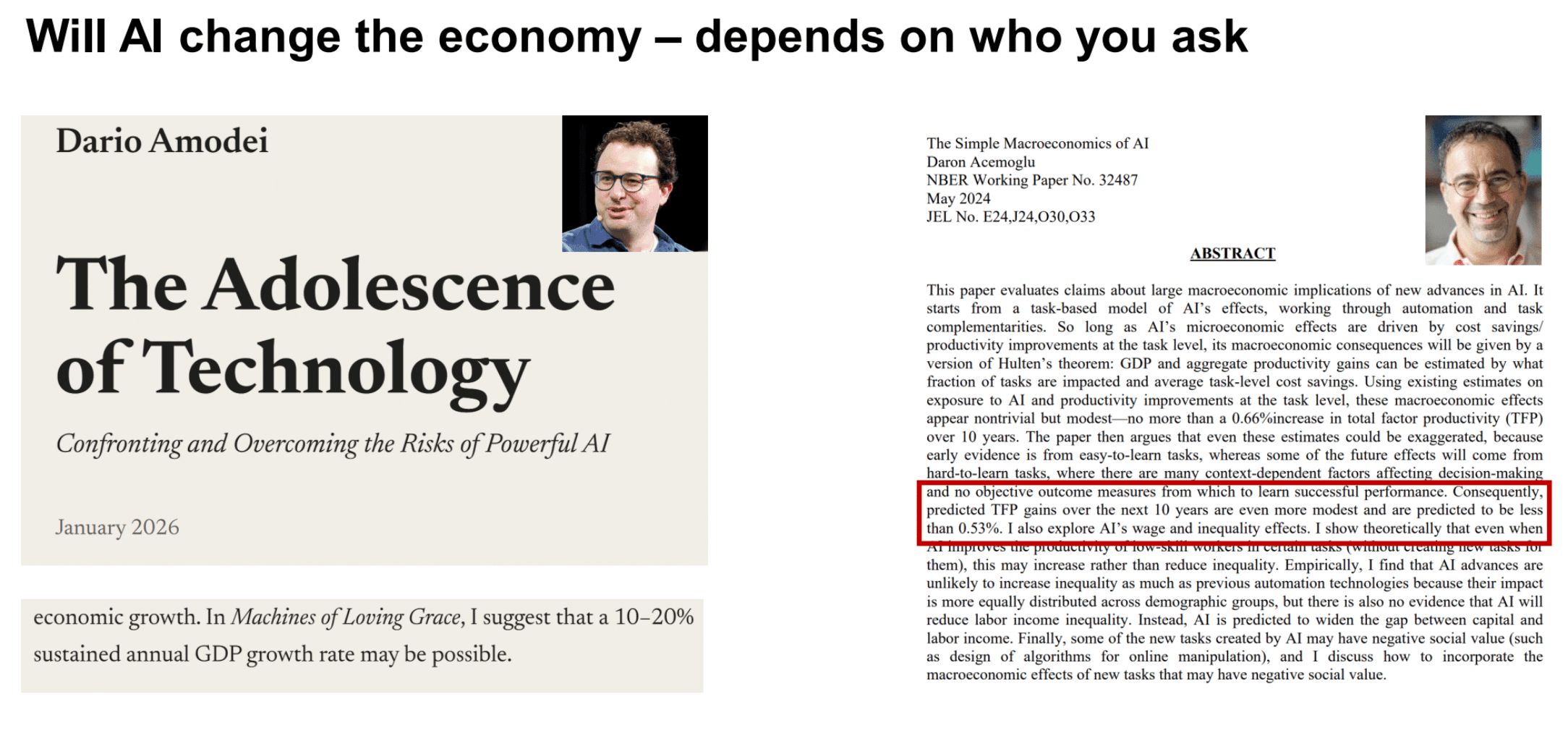
The debate about AI's economic impact sits between two poles. On one end, you have Dario Amodei's Machines of Loving Grace essay, which suggests AI could drive 10 to 20 percent sustained annual GDP growth. On the other, you have Daron Acemoglu's NBER analysis, which estimates AI's total factor productivity gains at no more than 0.53 percent over a decade — and argues even that may be overstated.
To get actual firm-level data on this, my co-authors and I partnered with four central banks — the U.S. Federal Reserve (via the Survey of Business Uncertainty), the Bank of England, the German Bundesbank, and the Reserve Bank of Australia — to survey nearly 6,000 CFOs and CEOs of large firms between November 2025 and January 2026. We published the results as "Firm Data on AI", NBER Working Paper 34836. It's the first major representative international survey of firm-level AI use.
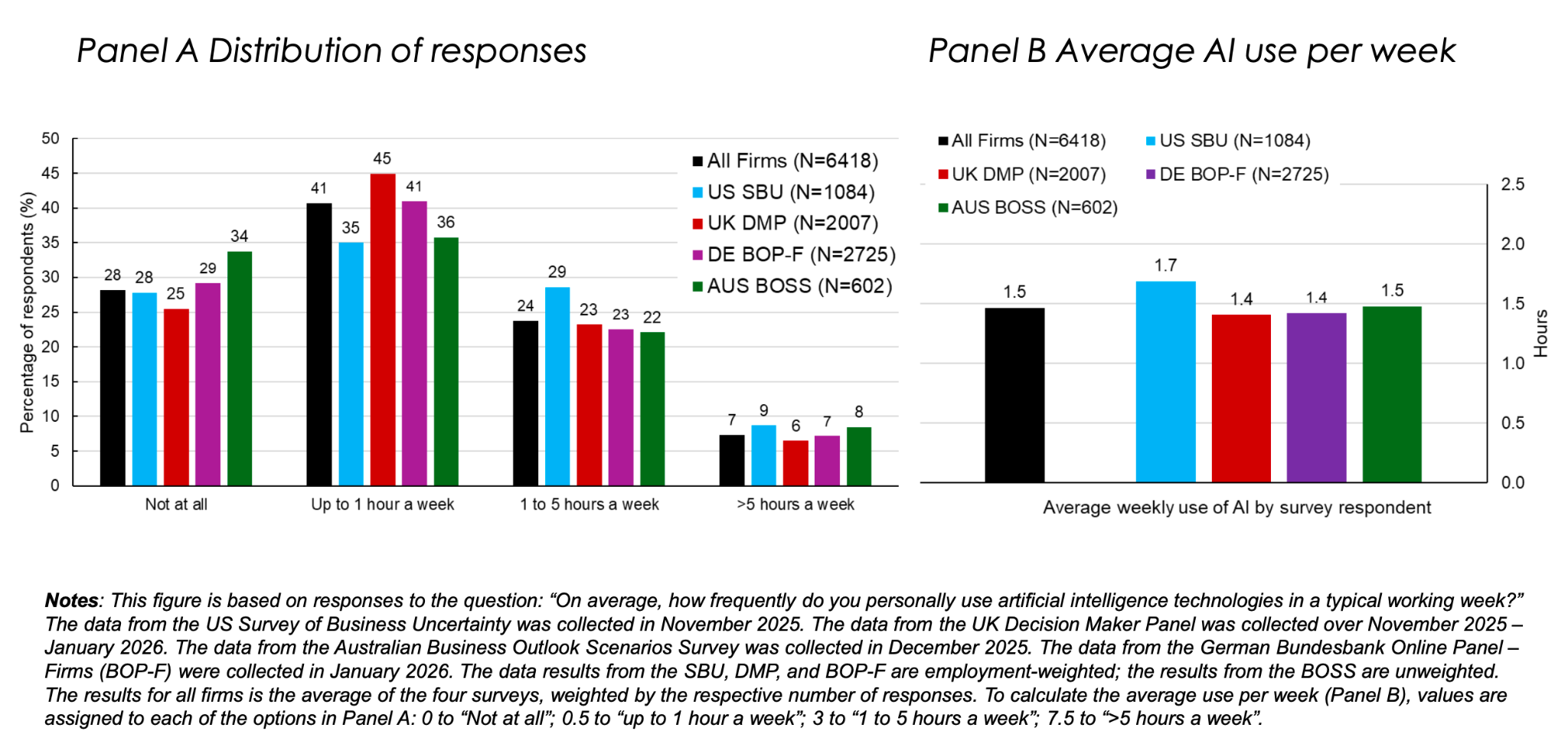
Here's what we found. About 70 percent of firms are actively using AI. But executive usage is surprisingly modest — the average CEO or CFO only uses AI about 1.5 hours per week. A full quarter of executives don't use it at all. This is not a story of ubiquitous, deep integration. Not yet.
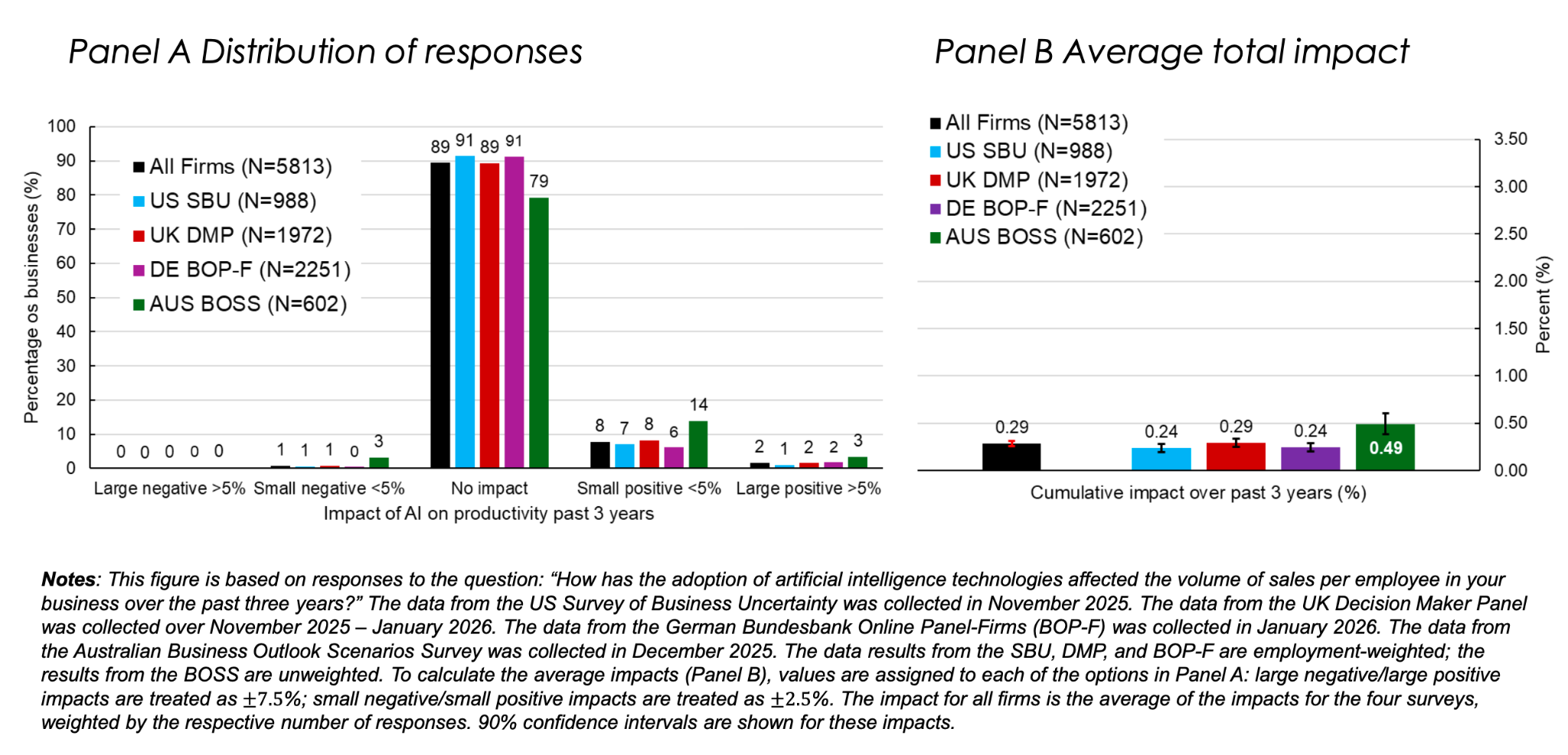
When we asked about AI's impact on productivity over the past three years, the answer was almost comically flat. Across all four countries, roughly 89 percent of firms reported no material impact. The average cumulative productivity boost was 0.29 percent. Tiny.
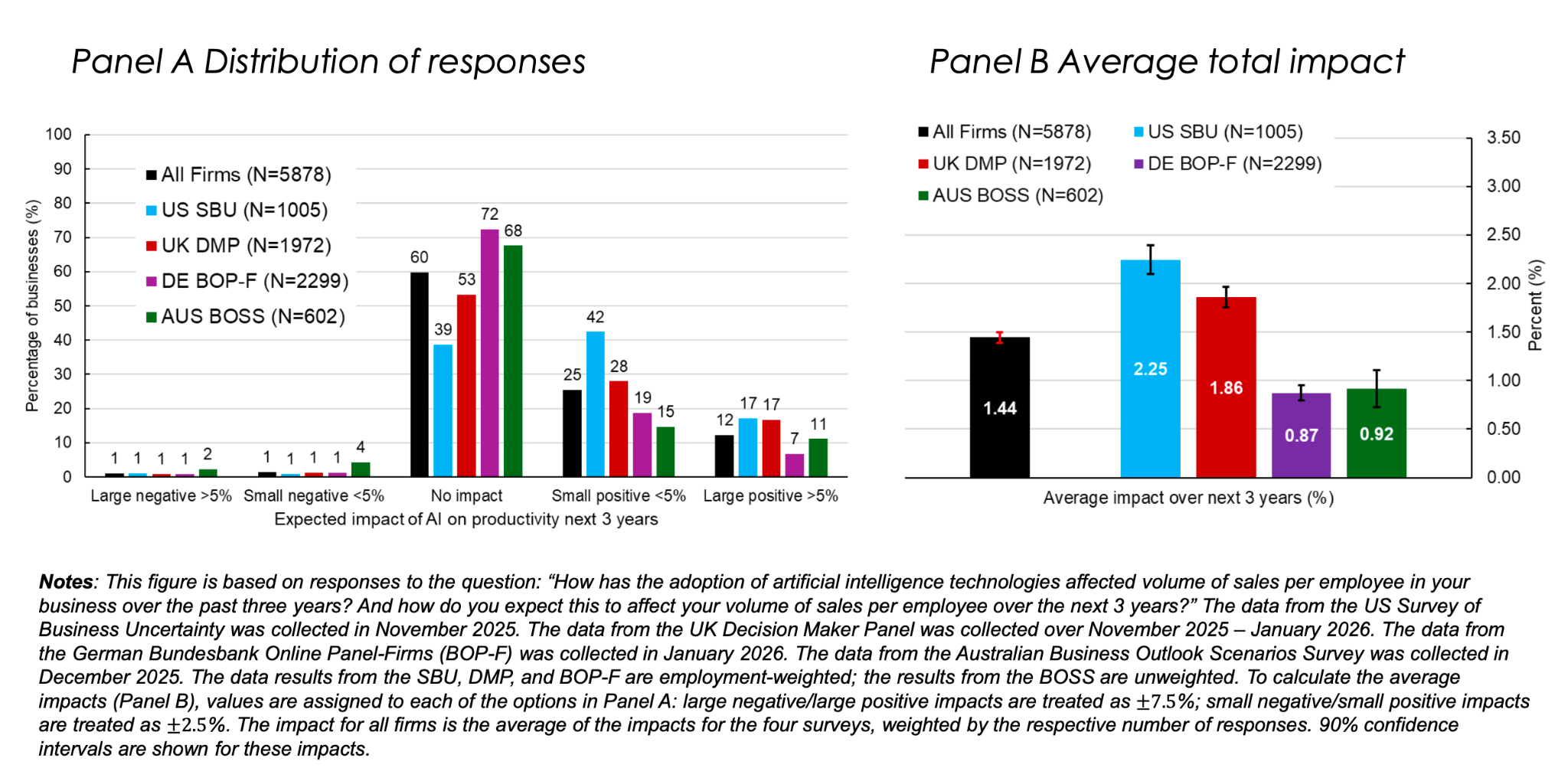
But here's where it gets interesting. When we asked the same executives about the next three years, the picture flipped dramatically. The average expected productivity gain was 1.44 percent across all firms — nearly five times the past-three-year impact. U.S. firms were the most optimistic, projecting a 2.25 percent boost. The gap between past impact and expected future impact is enormous, and it tells you something important: firms believe the transformation is coming, even if it hasn't arrived yet.
AI Is Being Adopted Faster Than Almost Anything We've Measured
One of the most striking findings from my recent research with Aakash Kalyani, Marcela Carvalho, Tarek Hassan, Josh Lerner, and Ahmed Tahoun — published in the Quarterly Journal of Economics — is how fast AI is diffusing compared to other technologies.
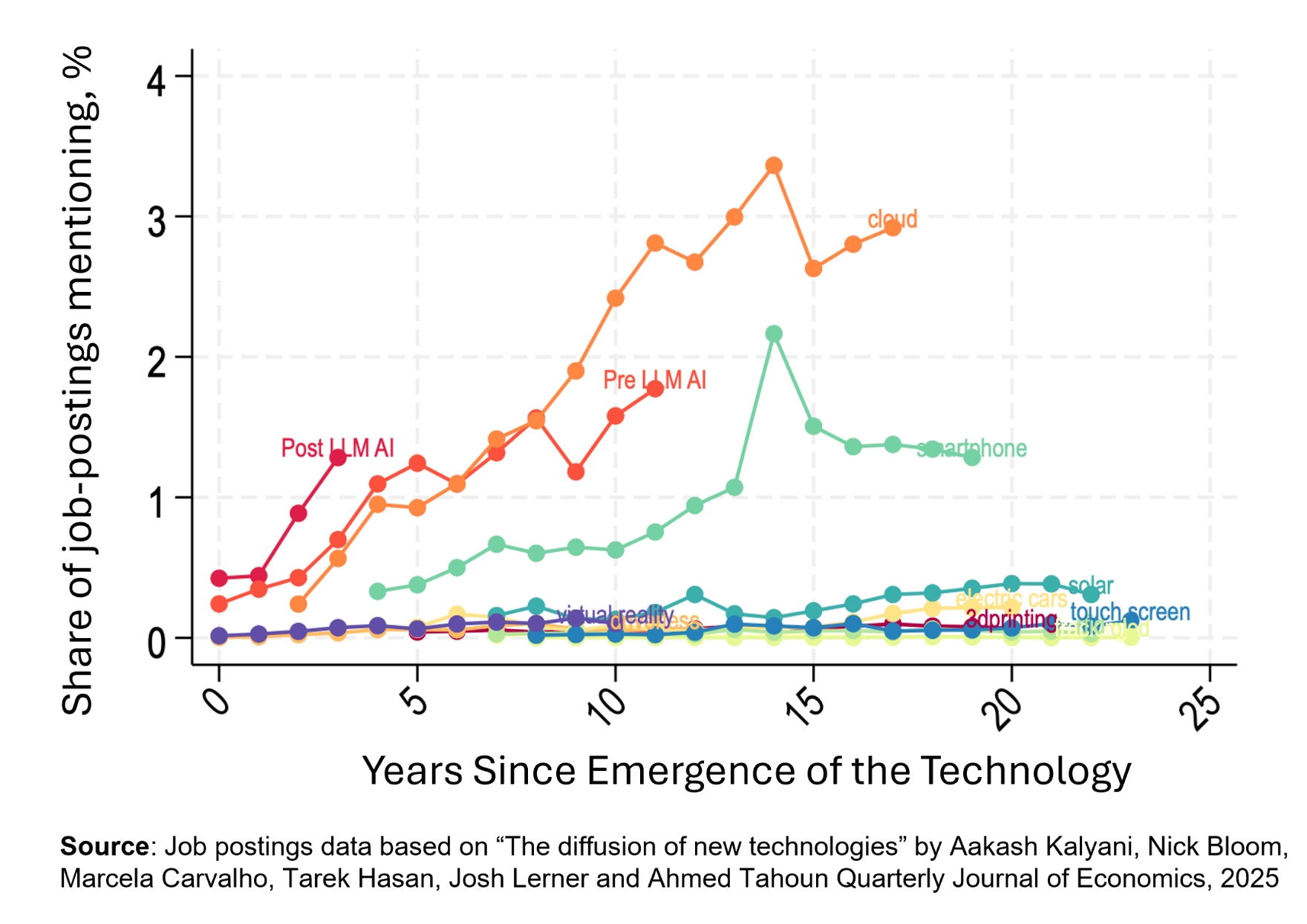
We tracked the share of job postings mentioning various technologies over time. Post-LLM AI is being adopted in the labor market faster than cloud computing, smartphones, solar energy, virtual reality, or 3D printing were at the same stage. The slope of the AI curve is steeper than anything else in our dataset. That speed of adoption — combined with the gap between current and expected productivity impact — suggests we're in an early phase where firms are experimenting and building capabilities, but the macro-level productivity gains haven't shown up in the aggregate statistics yet.
This pattern is actually typical of major technologies. There's always a lag between adoption and measurable economic impact. Electricity took decades. The internet took years. AI is moving faster, but it still takes time for firms to reorganize their workflows, retrain workers, and figure out which applications actually generate value.
What AI Is Already Doing to Careers — Especially in Software
Where AI's impact is already measurable is in hiring — specifically, in software engineering.
I keep hearing from founders that they're slowing coder hiring. One company I spoke to recently described their new "AI Factory Model," where AI generates the bulk of the code and engineers direct, validate, and ship. They off-boarded 21 full-time contracted engineers as a result. Anecdotes like this are multiplying.
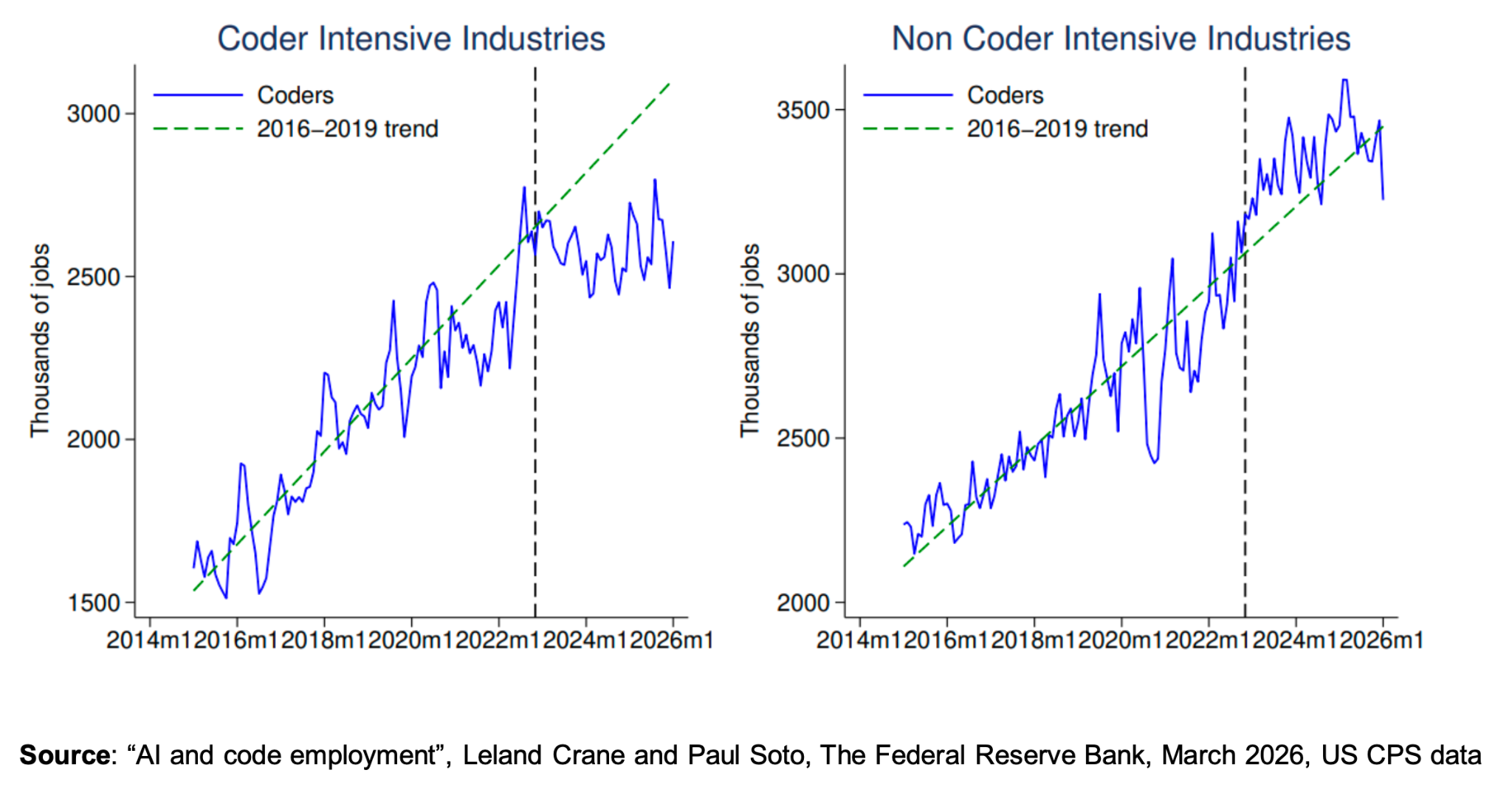
The hard data confirms it. A March 2026 study by Federal Reserve economists Leland Crane and Paul Soto found that aggregate employment of coders has decelerated sharply since the introduction of ChatGPT. Before November 2022, programming-intensive jobs were growing at roughly 5 percent annually. Since then, growth has fallen sharply — and in coder-intensive industries, it has essentially flatlined. Using CPS data and controlling for industry-level shocks, they showed the deceleration is occupation-specific, not just a byproduct of the broader tech pullback.
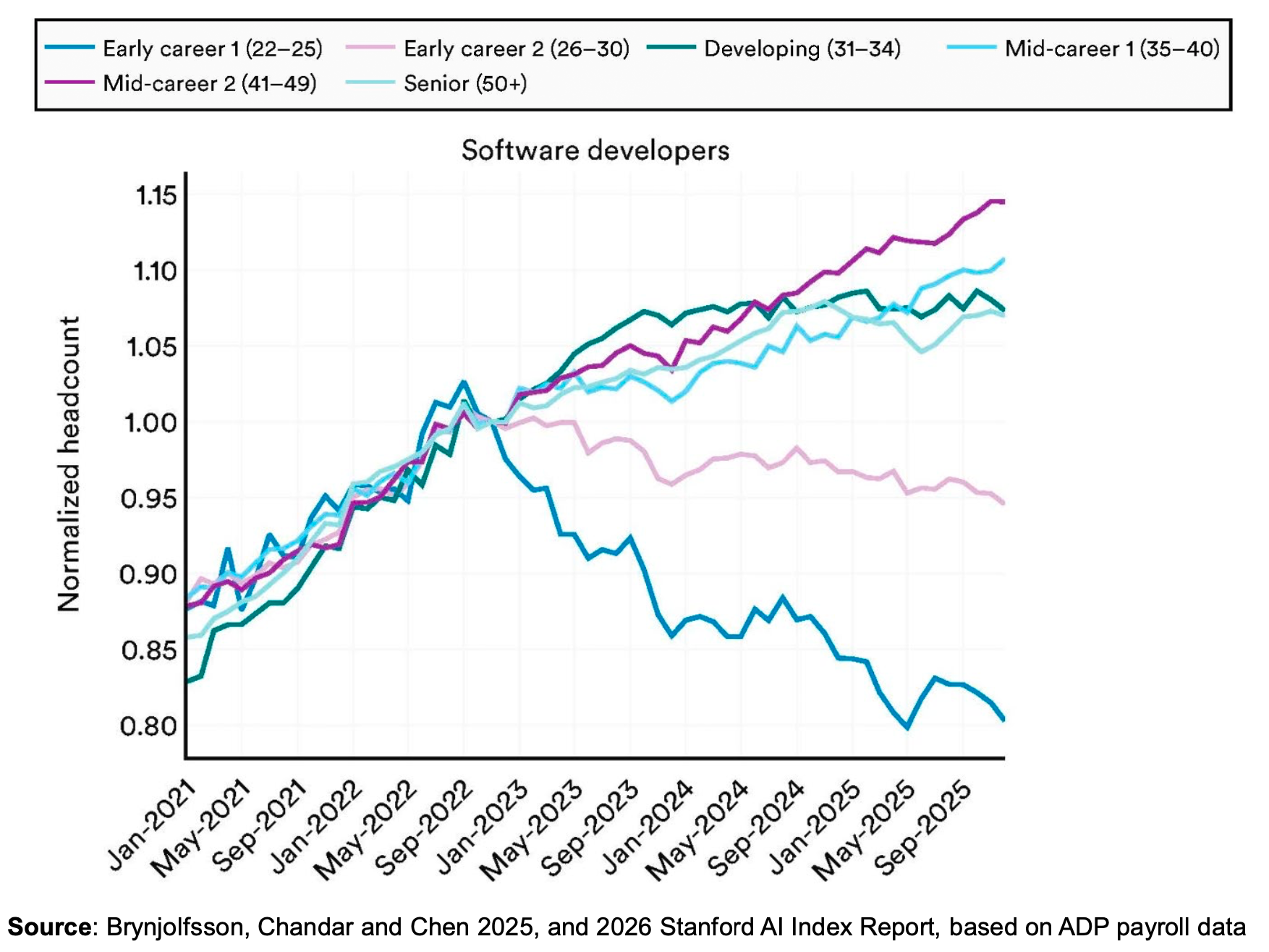
The impact looks strongest on early-career hiring. ADP payroll data analyzed by Brynjolfsson, Chandar, and Chen — and highlighted in the 2026 Stanford AI Index Report — shows that normalized headcount for early-career software developers (ages 22–30) has dropped significantly since mid-2022, while mid-career and senior developer headcount has held steady or grown.
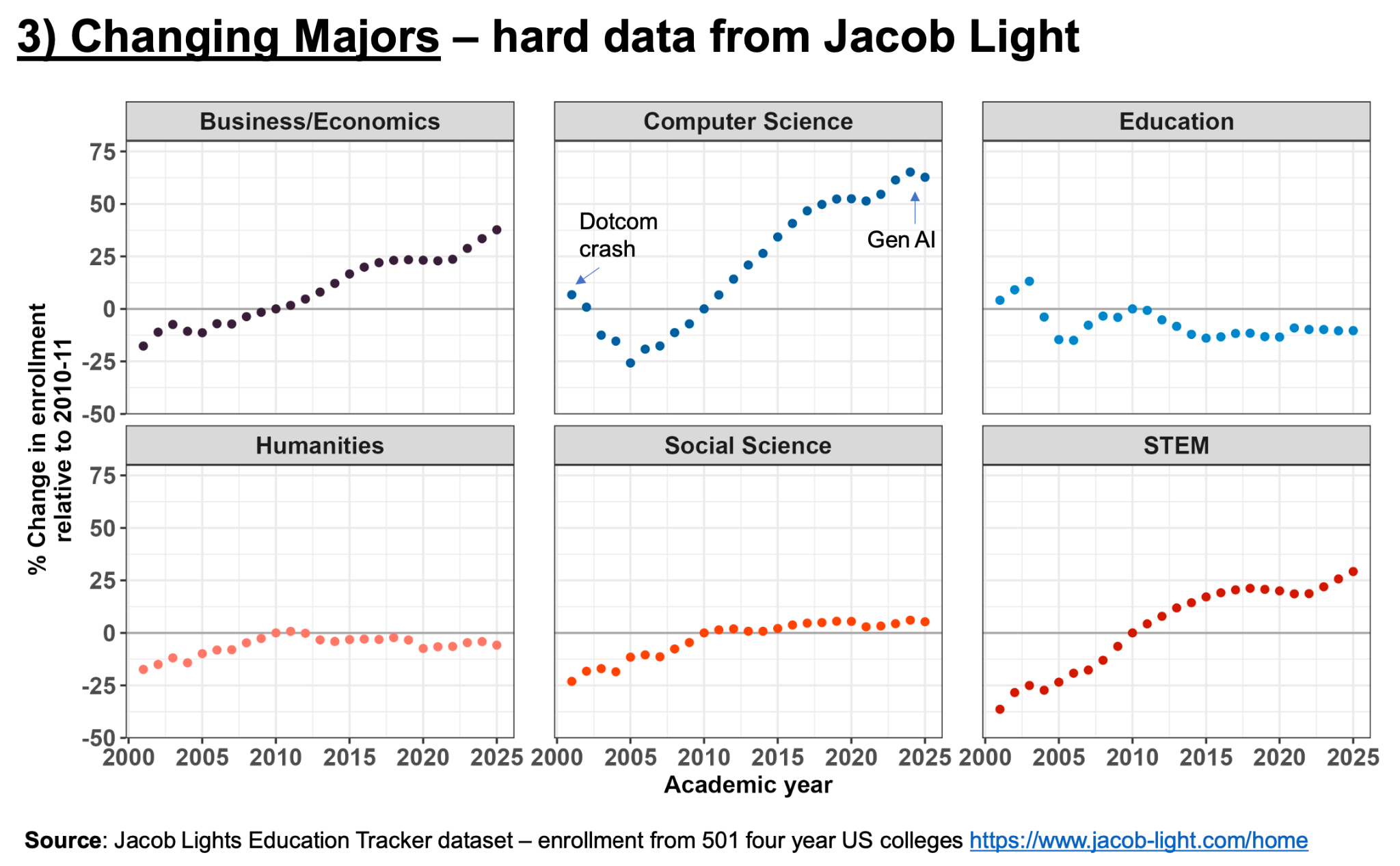
This has downstream consequences. At Stanford, I'm seeing three trends among students: more job applications (AI-generated applications are driving an arms race), more networking (since AI-written cover letters all look the same, referrals now carry more signal), and shifting majors. CS enrollment at Princeton, and anecdotally at other schools, has begun to decline — consistent with what you'd expect if students are reading the labor market signals.
Why This Matters If You're a Founder
So what does all this mean if you're running a startup in 2026?
First, your headcount projections are genuinely uncertain. AI is not yet visibly boosting firm-level productivity, but executives overwhelmingly expect it to within three years. If they're right — even partially — your team in 2029 may be meaningfully smaller than what you'd project using 2024 hiring curves. The cautionary tale I keep returning to: a major tech company demolished an existing office building to construct a new one twice the size, only to discover — as AI began capping their headcount projections — that they had dramatically overbought. Don't make the same mistake with your lease.
Second, the composition of your team is likely to shift. The data suggests AI is most directly affecting junior technical roles. If you're hiring engineers, you may need fewer of them, but the ones you do hire need to be more senior, more capable of directing AI-assisted workflows, and more productive per person. That changes your space needs — fewer desks, more collaboration zones.
Third, speed and flexibility matter more than ever. The firms in our central bank survey that were already using AI more intensively tended to be younger, more productive, and faster-moving. That's not a coincidence. Startups have a structural advantage here — you can adopt AI tools faster, reorganize more quickly, and make real estate decisions that reflect the world as it actually is, not as it was three years ago.
The data is moving fast. We're running these surveys every six months, and we'll update this post as new results are published. In the meantime, the right strategy is the same one I'd recommend for your office lease: stay nimble, size for what you know, and don't lock in assumptions that the next twelve months may invalidate.
Nick Bloom is the William D. Eberle Professor of Economics at Stanford University, co-founder of WFH Research, and an advisor to Tandem. His research on AI, hybrid work, and productivity has been published in Nature, the Quarterly Journal of Economics, and the American Economic Review. For more on the Firm Data on AI project, visit firmdataai.com.
Last updated: October 2026
This post was created with the assistance of AI tools. All content was reviewed by the author.